
As applications grow, one of the most important architectural decisions engineers face is whether to build everything as a single application or split it into multiple independent services.
There isn't a universally correct answer.
Choosing the right architecture depends on factors such as your team's size, business requirements, scalability needs, operational maturity, and deployment strategy—not on what's currently trending.
This article compares Monolithic and Microservices architectures, explains their trade-offs, and provides practical guidance on when to choose each approach.
What is Monolithic Architecture?
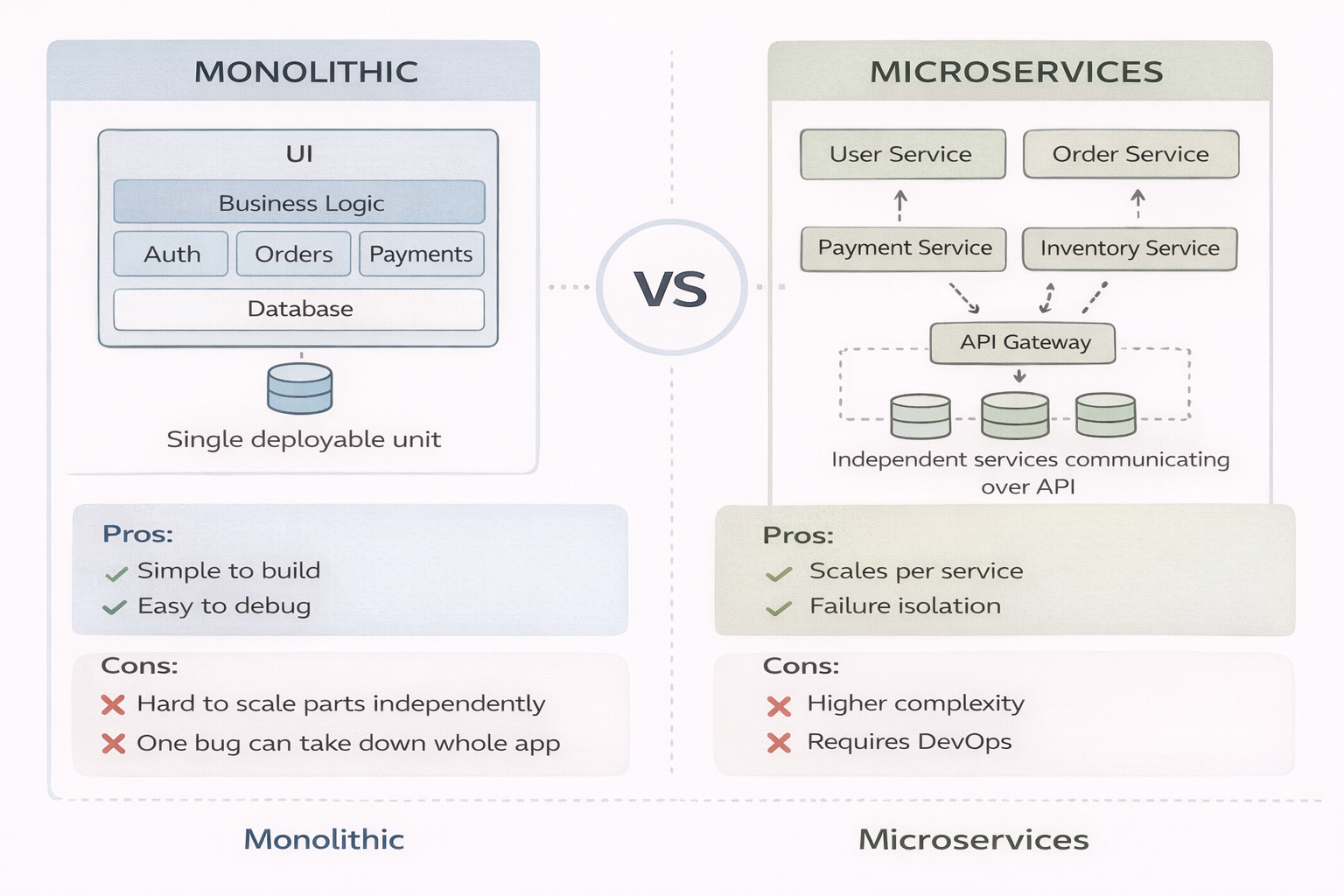
A Monolithic Architecture is an application where all components are developed, deployed, and maintained as a single unit.
Typically, a monolithic application contains:
- User Interface
- Business Logic
- Authentication
- Database Access
- APIs
- Background Jobs
Everything lives inside one codebase and is deployed together.
A monolithic architecture doesn't necessarily mean poor architecture. Well-designed monoliths can be modular, maintainable, and highly scalable for many business domains.
Example
Consider an e-commerce application.
It includes:
- User Management
- Orders
- Payments
- Inventory
All of these modules are packaged and deployed together as one application.
What is Microservices Architecture?
A Microservices Architecture breaks an application into multiple independent services, where each service owns a specific business capability.
Each service:
- Owns a single responsibility
- Has its own codebase
- Can be deployed independently
- Often manages its own database
- Communicates with other services using HTTP, gRPC, or asynchronous messaging
Example
The same e-commerce platform might consist of:
- User Service
- Order Service
- Payment Service
- Inventory Service
Each service can be developed, deployed, and scaled independently.
High-Level Comparison
| Aspect | Monolithic | Microservices |
|---|---|---|
| Codebase | Single | Multiple |
| Deployment | Single deployment | Independent deployments |
| Scaling | Entire application | Individual services |
| Complexity | Lower initially | Higher initially |
| Operational Overhead | Low | High |
| Failure Isolation | Limited | Better |
| Team Independence | Limited | High |
| Deployment Speed | Slower as project grows | Faster per service |
When Should You Choose a Monolith?
A monolith is often the best choice when:
- Building an MVP
- Working with a small engineering team
- The business domain is relatively simple
- Rapid iteration is important
- Operational simplicity is a priority
Examples include:
- Early-stage startups
- Internal business applications
- Small SaaS products
- Proof of Concepts
Many successful companies—including several unicorn startups—began with a monolithic architecture before evolving their systems over time.
When Should You Choose Microservices?
Microservices become valuable when organizational and technical complexity increase.
Consider microservices when:
- Multiple engineering teams work independently
- Different services have different scaling requirements
- High availability is critical
- Teams deploy frequently
- Business domains are clearly separated
Examples include:
- Large e-commerce platforms
- Financial systems
- Streaming platforms
- Enterprise SaaS products
Companies such as Netflix and Amazon successfully adopted microservices after reaching significant scale—not from day one.
Common Misconception
Microservices are not inherently better than monoliths.
They solve organizational and scalability problems—not small codebase problems.
Teams often adopt microservices too early and introduce unnecessary complexity, including:
- Distributed debugging
- Network latency
- Service discovery
- DevOps overhead
- Observability challenges
- Distributed transactions
Practical Rule of Thumb
Start with a well-structured monolith.
Move toward microservices only when real operational or organizational pain justifies the additional complexity.
Good software architecture evolves alongside the business.
Key Takeaways
- Monoliths are simple to build, deploy, and maintain.
- Microservices provide flexibility and independent scaling but introduce operational complexity.
- Team size and business requirements matter more than architectural trends.
- There is no universally superior architecture.
- The best architecture is the one that solves today's problems while allowing room for future growth.
Architecture Comparison
Conclusion
Both Monolithic and Microservices architectures have their place.
A monolith optimizes for simplicity, faster development, and lower operational overhead.
Microservices optimize for scalability, independent deployments, organizational growth, and resilience—but require significantly more operational maturity.
Instead of asking:
"Which architecture is better?"
Ask:
"Which architecture best solves my current business and engineering challenges?"
The answer will often change as your product and organization evolve.
References
- Martin Fowler — Monolith First
- Sam Newman — Building Microservices
- Eric Evans — Domain-Driven Design
- Chris Richardson — Microservices Patterns
Continue Reading
You may also enjoy:
- System Design Fundamentals (Coming Soon)
- CAP Theorem (Coming Soon)
- REST vs GraphQL (Coming Soon)
- Event-Driven Architecture (Coming Soon)